
Quick Facts
- What is a mosquito tornado? It is a massive, spinning vertical mating swarm (vortex) composed of millions of male insects—most commonly non-biting Chironomus midges or true mosquitoes.
- What causes them? Stagnant water bodies, organic river pollution (untreated sewage), and sudden spikes in humidity and temperature.
- Are they dangerous? While midges don’t bite, the environmental conditions that cause them breed disease-carrying mosquitoes, increasing risks of Dengue and Malaria.
- How do you stop them? Combine home exclusion (window screens, yellow lighting) with professional integrated pest management, like the targeted mosquito control services from Truly Pest Solutions.
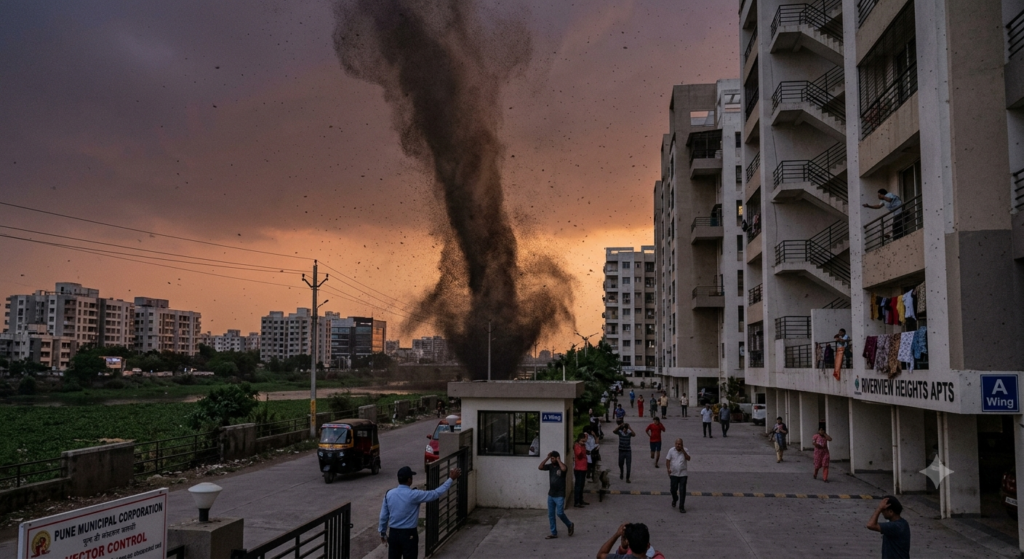
If you’ve recently spent time scrolling through social media, you might have come across terrifying videos of towering, dark vortexes swirling in the sky over residential areas. Dubbed “mosquito tornadoes,” this unusual phenomenon recently made headlines in Pune, India, where massive columns of swarming insects took over the skies near the Mula-Mutha River, sparking widespread panic among locals.
But what exactly is a mosquito tornado, why does it happen, and how can you protect your household? Let’s decode the science behind this bizarre visual and look at how Truly Pest Solutions can keep your property safe.
What Exactly Is a “Mosquito Tornado”?
While they look like something straight out of a horror movie or a severe weather alert, these columns are not actual meteorological tornadoes. Instead, they are massive, tightly packed mating swarms (known as “leks”).
When environmental conditions are precisely right, thousands—sometimes millions—of male insects gather in giant, swirling vortexes to attract females. The circular flying pattern creates a dense, towering visual column that can extend hundreds of feet into the air.
The Twist: Mosquitoes vs. Midges
Interestingly, entomologists and water-quality experts who analyzed the recent phenomenon noted that many of these swarms aren’t actually mosquitoes at all—they are often Chironomus midges (also known as non-biting midges).
| Feature | Culicidae (True Mosquitoes) | Chironomidae (Non-Biting Midges) |
| Biting Mechanism | Females possess long, piercing mouthparts to suck blood. | No elongated mouthparts; do not bite or sting. |
| Wings | Covered in tiny scales. | Smooth, translucent wings. |
| Resting Posture | Bodies are typically tilted upward or flat. | Keep their front legs raised off the ground. |
| Swarming Behavior | Swarm in smaller clouds, usually around dawn/dusk. | Form immense, towering vertical vortexes. |
Regardless of whether a swarm consists of true mosquitoes or non-biting midges, their sudden appearance points to a single, shared environmental root cause: uncontrolled stagnant water and organic pollution.
The Perfect Storm: Why Do They Form?
Insects don’t just gather into sky-high funnels out of nowhere. The phenomenon requires a specific recipe of ecological disturbances:
Slowing Water Flows: Infrastructure projects like small dams or water treatment facilities can intentionally or unintentionally slow down a river’s natural current.
Organic Pollution: High levels of untreated sewage, agricultural runoff, and industrial waste deplete oxygen in the water. While this kills off predatory fish, it creates a thriving buffet for midge and mosquito larvae, which excel at surviving in low-oxygen environments.
Elevated Temperatures and Humidity: Warm weather accelerates the insect life cycle, causing millions of pupae to hatch simultaneously into flying adults.
When millions of adults emerge at the exact same time, they instantly seek out mates, resulting in the jaw-dropping aerial vortexes seen over riverbanks and adjacent high-rise buildings.
The Hidden Hazards Behind the Spectacle
Even if a swarm is primarily composed of non-biting midges, a “tornado” of this scale introduces serious problems for local communities:
Severe Nuisance: The sheer volume of insects can force residents to stay indoors, seal balconies, and abandon local parks or outdoor public spaces.
Allergies: Inhaling airborne debris from millions of dead insects or shed pupal skins can trigger asthma attacks and allergic rhinitis in sensitive individuals.
Secondary Mosquito Spikes: The exact same stagnant, polluted conditions that breed midges are simultaneously breeding true, disease-carrying mosquitoes (Anopheles, Aedes, and Culex), spiking the risk of Dengue, Malaria, and Zika in nearby neighborhoods.
Defend Your Home: How Truly Pest Solutions Can Help
While large-scale river cleanup requires municipal intervention, protecting your family requires immediate, targeted defense on your own property. Regular retail bug sprays only kill the insects you see—they don’t stop the breeding cycle.
That is where professional intervention becomes vital. At Truly Pest Solutions, we offer comprehensive mosquito control services specifically engineered to handle large-scale vector outbreaks and neighborhood swarms.
Our Advanced Integrated Mosquito Management (IMM) Approach
Quick Home Tips to Prevent Swarms
Alongside calling in Truly Pest Solutions to use mosquito control services, you can maintain a baseline defense with these simple habits:
Fortify Entry Points: Install fine-mesh insect screens (minimum 20×20 mesh size) on all windows and balcony doors.
Optimize Your Lighting: Swap out standard outdoor white bulbs for yellow LED “bug lights” to significantly reduce the numbers drawn to your windows and balconies.
Eliminate Micro-Breeding Sites: Empty, scrub, and flip over any containers holding water—such as AC tray runoffs, flowerpot saucers, and terrace drains weekly.
Don’t wait for the next swarm to cloud your skies. Protect your residential complex, commercial property, or standalone home with the ultimate shield.