
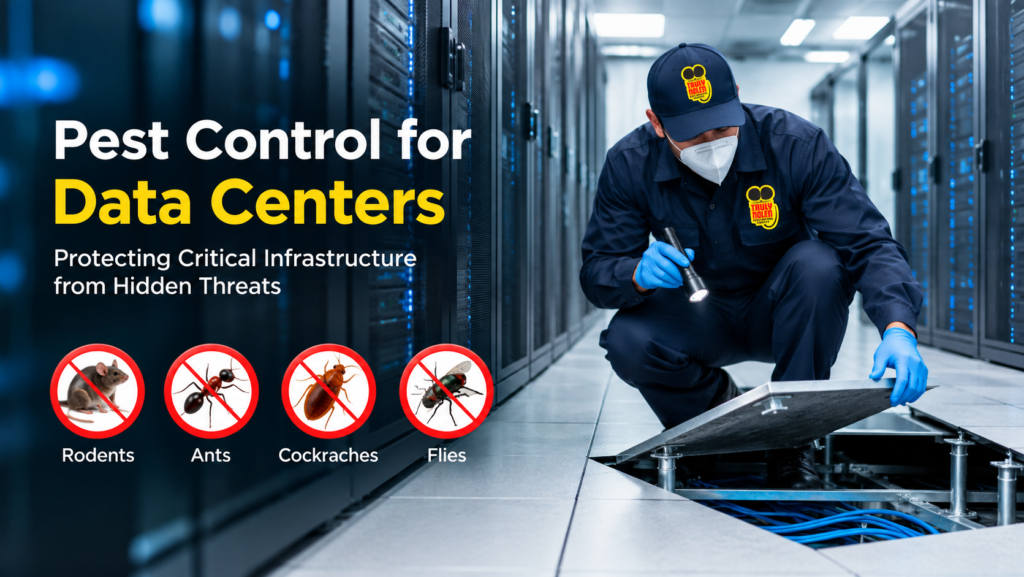
The Data Center Immune System: Preventing Pest-Induced Outages in Critical IT Infrastructure
Data centers represent the digital heartbeat of the modern global economy.
Operating 24×7 for 365 days, these facilities require uninterrupted power, strict thermal regulation, and absolute environmental integrity.
Yet, facility managers often overlook a silent, high-stakes threat lurking beneath raised floors and inside cable trays: biological pests.
When a single rodent can trigger a multi-million-dollar outage by chewing through high-density cabling or bridging electrical circuits, pest control transcends routine maintenance. It becomes a core pillar of mission-critical risk management.
The Hidden Vulnerabilities of Modern Data Centers
Modern data centers are engineered for high efficiency, featuring hot/cold aisle containment, advanced HVAC systems, and high-density server racks. Ironically, these very design elements create ideal micro-habitats for specific pests:
- Thermal Micro-Climates: While server rooms are kept cool, sub-floor plenums, electrical rooms, and utility chases often feature stable, warm temperatures that attract rodents and insects.
- Abundant Pathways: Raised access floors, cable penetrations, conduit entries, and generator fuel storage areas provide hidden transit networks for pests to travel unimpeded.
- Organic Attractants: Food waste from on-site control rooms, packaging materials in loading bays, and administrative offices provide sustained food sources if sanitation protocols falter.
High-Risk Vectors: What Lurks Beneath the Floor
Traditional pest control relies on reactive spraying and general chemical applications. In a data center environment, traditional approaches can be catastrophic—pesticide residue can corrode sensitive hardware, and standard traps do not address the root entry points.
- Rodents (Mice and Rats): Driven by a biological imperative to gnaw continuously to keep their incisors worn down, rodents target polyvinyl chloride (PVC) and other insulation materials on power and fiber-optic cables, causing catastrophic short circuits or data pipeline failures.
- Insects (Ants and Cockroaches): Certain species of ants are attracted to electromagnetic fields generated by high-voltage transformers and power distribution units (PDUs). Their nesting activities bridge electrical contacts, resulting in equipment failure and arc flashes.
- Stored Product Pests and Flies: Though less destructive to hardware, flying insects can bypass air curtains and clog sensitive optical equipment or trigger false alarms in aspirating smoke detection systems (VESDA).
Designing an Integrated Pest Management (IPM) Strategy
A data center demands precision, prevention, and complete traceability—making a robust Integrated Pest Management (IPM) program essential. Our digitally enabled approach combines proactive inspections, risk-based monitoring, preventive recommendations, and technology-driven service documentation to protect critical infrastructure. Every activity is digitally recorded, enabling real-time visibility, audit readiness, compliance, and data-driven decision-making—with minimal dependence on chemical interventions around critical equipment.
- Exclusion Engineering: Seal all cable penetrations, pipe entries, and weep holes using expanding fire-rated foams, stainless steel mesh, and structural caulking to create an impenetrable physical barrier at the perimeter.
- Environmental Controls: Maintain strict humidity and temperature differentials in sub-floor plenums and keep loading dock doors sealed via automated interlocking mechanisms to eliminate entry vectors.
Securing Your Infrastructure Continuity
Data center downtime is measured in thousands of dollars per minute, and the reputational damage of a preventable outage can last for years.
Integrating advanced, non-invasive pest prevention into your critical facilities management framework ensures absolute uptime, regulatory compliance, and total asset protection.
Ready to bulletproof your data center against biological threats? Contact our team today at 1800-11-3665 to schedule a comprehensive, non-disruptive site vulnerability assessment.
Frequently Asked Questions
Why is pest control important for data centers?
Pest control is important for data centers because rodents and insects can damage electrical cables, server infrastructure, insulation, and other critical equipment. A single infestation can cause equipment failure, service disruption, data loss, and costly downtime. A preventive pest management program helps identify entry points and control pest risks before they affect operations.
What pests are commonly found in data centers?
The most common data center pests include rats, mice, ants, cockroaches, and flies. Rodents can chew electrical and fiber-optic cables, while ants and cockroaches may enter electrical equipment and create contamination or short-circuit risks. Flying insects can also interfere with sensitive equipment and detection systems.
How can data centers prevent rodent and insect infestations?
Data centers can prevent infestations by sealing cable penetrations and other entry points, maintaining clean loading and storage areas, controlling food waste, monitoring pest activity, and conducting regular inspections. An Integrated Pest Management (IPM) program combines these preventive measures with targeted pest control to minimize the need for chemical treatments around sensitive equipment.
Is pest control safe for servers and sensitive data center equipment?
Yes, when pest management is specifically designed for critical environments. Data centers should use targeted, non-invasive control methods, strategic monitoring, exclusion techniques, and carefully selected treatments that minimize exposure of servers and electrical equipment to chemicals, moisture, and residues.
How often should a data center have pest control inspections?
Data centers should have regular pest inspections and continuous monitoring, with the exact frequency based on the facility’s location, size, environmental conditions, pest pressure, and risk profile. High-risk facilities may require more frequent inspections and monitoring as part of a documented Integrated Pest Management program.