
1. Decoding Pest-Management Mandates Across FSSC 22000 and BRCGS
Auditors from certifying bodies aren’t just looking to see if you have rodent traps placed around the perimeter. They are evaluating the robustness, documentation, and scientific rationale of your entire pest defense system.
- The Risk Assessment Foundation (HACCP): Pests are classified as a major biological, chemical, and physical hazard. Your pest management program must stem directly from a documented vulnerability assessment of your facility, identifying specific entry points, harborage areas, and critical control points (CCPs) or operational prerequisite programs (PRPs).
- Structural Exclusion (FSSC 22000 / BRCGS): Modern standards heavily emphasize building design and exclusion over chemical intervention. Auditors will inspect external doors, air curtains, loading dock seals, and drainage grates. If a rodent can squeeze through a 6mm gap under a warehouse door, your documentation won’t save you from a major non-conformance.
- Chemical Control & Residue Avoidance: In a beverage plant, the use of pesticides near open product lines, syrup rooms, or water treatment units is heavily restricted. Standards require strict verification that any chemical application cannot result in product contamination or chemical residue drift.
2. The Unique Vulnerabilities of Beverage Manufacturing
Beverage plants present a distinct ecological magnet for pests. Understanding these hotspots is vital for plant operations and quality teams keeping their audit scores flawless:
- High Moisture and Sugar Corridors: Sticky syrup spills, condensation around cooling towers, and floor drain accumulation create prime breeding grounds for drain flies, fruit flies, and German Cockroaches Control targets.
- The Packaging Material Vector: Corrugated cardboard boxes, shrink wrap, and pallets brought into the warehouse frequently harbor stored-product insect eggs or Rodent Control Services nesting materials.
- Night-Shift Vulnerabilities: Many beverage facilities operate 24/7. Pests often exploit quiet periods during sanitation shifts or loading dock movements when high-volume doors remain propped open.
3. A 4-Step Blueprint for Audit-Ready Pest Compliance
To transform your pest management program from an audit liability into a competitive advantage for your production floor, beverage operations should implement a proactive, digitally integrated framework:
Step 1: Shift from Reactive Spraying to Integrated Pest Management (IPM)
Auditors look unfavorably on facilities that rely solely on blanket chemical spraying. True IPM prioritizes sanitation, exclusion, and biological monitoring. Focus heavily on sealing building envelopes, fixing leaking seals around pipes, and maintaining air pressure balances to prevent flying insects from entering production zones.
- Risk-Rate Your Zones: Don’t inspect every area with the same intensity. Rate each zone according to pest pressure, product exposure, traffic, moisture, and structural vulnerability.
- Create a Beverage Plant Pest Risk Map: Cover syrup/concentrate rooms, CIP areas, drains, filling/packing halls, raw-material receiving docks, pallet storage, waste areas, utility rooms, and the external perimeter.
- The CAPA Workflow: For every high-risk observation, follow a simple Identify → Photograph → Risk-rate → Assign CAPA → Correct → Verify → Close digitally.
- Practical Rule: If daylight is visible under a door or around a service penetration, or a drain cover is damaged, treat it as a pest-risk observation and raise it for corrective action.
“The objective is not zero pest sightings; the objective is zero uncontrolled pest risk.”
Step 2: Digitize Your Documentation and Trend Analysis
Paper logbooks stored in a dusty binder are a red flag for modern auditors. FSSC 22000 and BRCGS expect real-time traceability and trend analysis.
- Digital Reporting Systems: Technicians must log trap activity, pesticide usage data, and corrective actions instantly via mobile or tablet applications.
- Turn Data into Intelligence: One pest sighting is an event; repeated sightings at the same location are a trend. For example, repeated fly activity near a syrup or filling area should trigger an investigation of drains, moisture, sanitation, waste handling, air movement, and possible entry routes—not simply additional spraying.
- Trend Dashboards: Maintain dashboards that track pest activity by zone, repeat findings, open CAPAs, device compliance, and seasonal movement. Every recurring finding must have an identifiable root cause, responsible owner, target closure date, and verification record.
Step 3: Implement Non-Toxic, Digital Monitoring in Sensitive Zones
In high-risk liquid processing and filling halls, traditional rodenticides are often prohibited due to the risk of secondary poisoning or product contamination.
- Utilize smart, connected, non-toxic multi-catch traps and digital monitoring nodes alongside specialized Fly Catching Machines to manage flying insects safely.
- These provide instant alerts to your facility management the moment activity is detected, ensuring zero interruption to bottling lines and complete compliance with audit hygiene requirements.
- Define the Response Path: Monitoring is only valuable when tied to an escalation protocol: Alert received → Technician verification → Site/zone inspection → Root-cause investigation → Corrective action → Closure verification.
- Maintain device-location maps so QA and auditors can quickly understand what is monitored and where.
Step 4: Conduct Pre-Audit ‘Mock’ Walkthroughs
Don’t wait for the annual audit to test your system. Conduct regular cross-functional walkthroughs with your quality assurance and pest management partners from Truly Nolen India.
- The 30-Minute Beverage Plant Pest Audit Challenge: Select one high-risk production or warehouse zone and ask five questions:
- Can any pest enter this zone?
- Where could it hide or breed?
- What evidence would prove pest activity?
- What corrective action is currently open?
- Can we demonstrate the complete digital history to an auditor?
4. Auditor Observations & Corrective Actions Reference Guide
|
Auditor Observation / Finding |
Immediate Plant Action Required |
|
Cockroach near a drain |
Record and inspect; investigate drain hygiene, moisture levels, and nearby structural entry points. |
|
Rodent activity near a loading dock |
Increase monitoring; check dock seals, door gaps, traffic discipline, and external harborages. |
|
Fly activity near a filling area |
Verify monitoring nodes; investigate drains, waste management, moisture, and HVAC air movement. |
|
Pest activity in a warehouse |
Isolate and inspect the affected zone; review incoming pallets, packaging materials, and stock rotation practices. |
|
Open pipe / service penetration |
Raise a CAPA; seal the penetration immediately and verify effectiveness. |
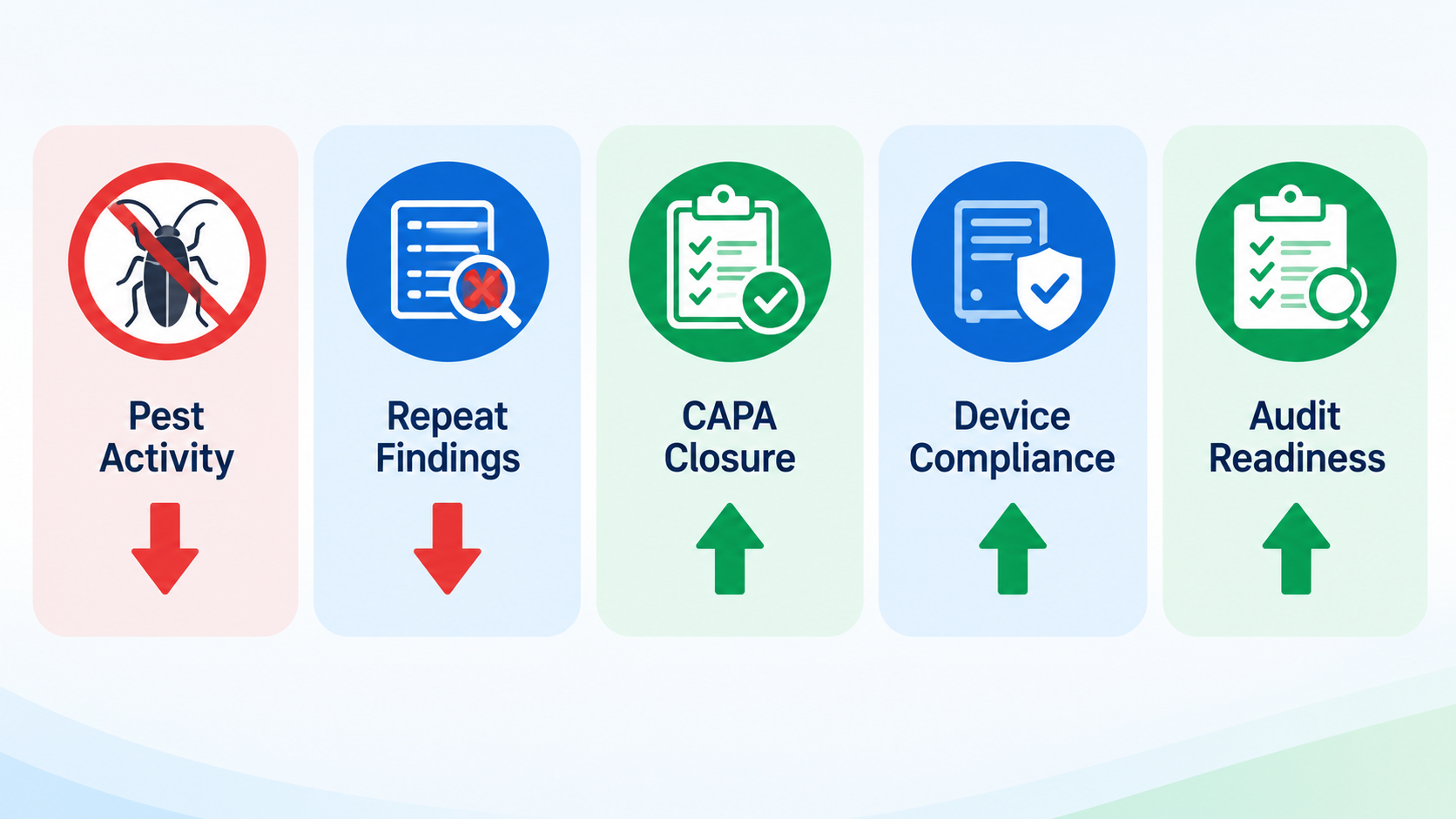
5. Core KPIs for Beverage Plant Pest Management
Track these six key performance indicators to measure the health of your bio-security program:
- Pest Activity Trend: Month-on-month activity categorized by pest type and plant zone.
- Repeat Activity: Number of locations showing recurring pest activity.
- CAPA Closure: Percentage of structural and sanitation corrective actions closed within agreed timelines.
- Device Compliance: Percentage of monitoring devices correctly positioned, accessible, and operational.
- High-Risk Zone Compliance: Compliance status of filling, syrup, raw-material, and warehouse areas.
- Audit Readiness: Immediate availability of current maps, service records, chemical logs, trend reports, and CAPA evidence.
Management Target View
The Bottom Line
For beverage quality and plant heads, pest management compliance is ultimately about safeguarding consumer health, protecting brand equity, and maintaining production continuity.
By moving away from outdated, reactive extermination models and embracing a rigorous, data-backed Integrated Pest Management strategy aligned with FSSC 22000 and BRCGS requirements, you ensure that your plant remains safe, compliant, and continuously running.